State News
McMorrow Out, El-Sayed and Stevens Remain: Michigan's 2028 Senate Race Reshapes with Implications for Arab American and Metro Detroit Voters
By Staff · July 17, 2026
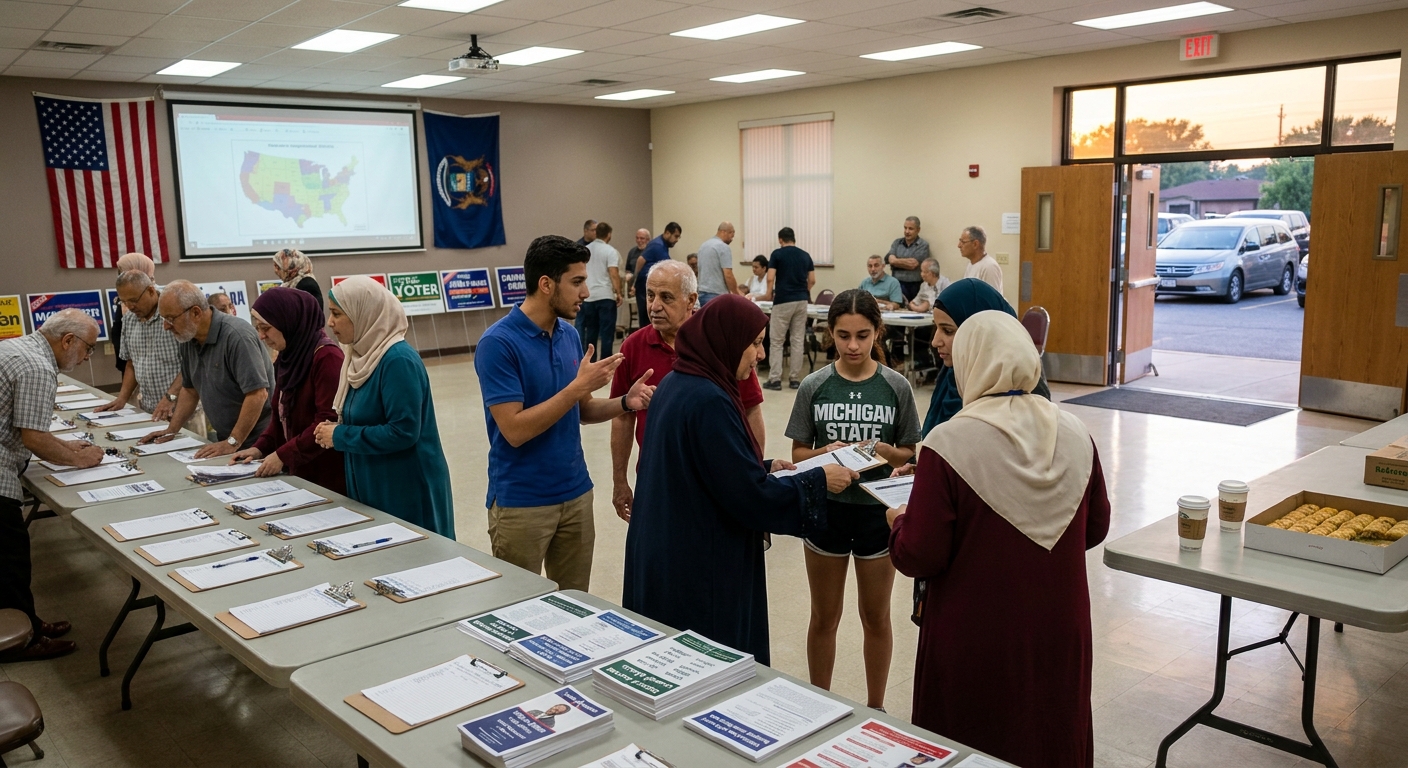
Dearborn voters who have long pressed Democrats to treat their community as more than an Election Day constituency now face a sharper choice in Michigan's Senate primary. Michigan state Sen. Mallory McMorrow suspended her U.S. Senate campaign July 5, leaving Rep. Haley Stevens and Abdul El-Sayed as the two Democratic candidates headed into the Aug. 4 primary. McMorrow's campaign collapsed after weeks of falling poll numbers and backlash over resurfaced social media comments in which she criticized rural Americans and white working-class voters.
Gary Peters' U.S. Senate term expires Jan. 3, 2027, and the 2026 election will fill the seat Peters is vacating after announcing in January 2025 that he would not seek reelection. The winner of the Aug. 4 Democratic primary is expected to face Republican Mike Rogers in what is considered one of the country's most closely watched and expensive Senate races. Dearborn became the nation's first Arab-majority city in 2023 and has the largest Muslim population per capita in the U.S.
McMorrow's departure turns what had been a three-way contest into a direct test of whether Dearborn's Arab American and Muslim voters can help elevate a candidate rooted in their community—or whether Michigan Democrats will again favor the candidate backed by the party's established network.
Abdul El-Sayed is an Arab American and Muslim physician born in Detroit on Oct. 31, 1984, and raised in Southeast Michigan by his father, Mohamed El-Sayed, an Egyptian immigrant and engineer, and his stepmother, Jacqueline El-Sayed. He currently lives in Ann Arbor with his wife, Sarah Jukaku, a mental health doctor, and two daughters, Emmalee and Serene.
El-Sayed served as Health Director for the City of Detroit from 2015 to 2017—the youngest health official in a major U.S. city at the time of his appointment—and as Director of Wayne County's Department of Health, Human, and Veterans Services from March 2023 until April 2025, when he resigned to run for Senate. In those roles, he led initiatives that erased $700 million in medical debt, built an air quality monitoring system, provided free glasses for children, removed lead from schools, and expanded Narcan access. He holds an MD from Columbia University, a PhD in public health from the University of Oxford as a Rhodes Scholar, and a bachelor's degree in biology and political science from the University of Michigan.
El-Sayed has secured endorsements from Dearborn-area elected officials, including Mayor Abdullah Hammoud, the Arab American Political Action Committee, and the United Auto Workers, Michigan's most prominent labor union, which endorsed him in early June 2026. U.S. Rep. Alexandria Ocasio-Cortez endorsed El-Sayed on July 2, 2026, calling him the strongest candidate to keep the open Senate seat in November.
"Choose the kind of representation we want—not just for our community but for our state and our country," Abdul El-Sayed, U.S. Senate candidate, said.
El-Sayed ran for Michigan governor in the 2018 Democratic primary and lost to Gretchen Whitmer. If elected, he would be the first Muslim senator and one of only seven Arab Americans to serve in the chamber.
Rep. Haley Stevens represents Michigan's 11th Congressional District, which includes most of urbanized Oakland County and many of Detroit's northern suburbs, and has served since Jan. 3, 2019. Stevens was born in Rochester Hills, Michigan, on June 24, 1983, and worked as Chief of Staff for the U.S. Auto Rescue Task Force from 2009 to 2011 before entering electoral politics. She won her first House election in 2018 with 51.8% of the vote, flipping the seat from Republican to Democratic, and was reelected in 2020 with 50.2%, in 2022 with 61.3%, and in 2024 with 58.2%. From January 2019 to July 2024, Stevens missed only 3 of 3,031 roll-call votes (0.1%), far better than the median of 2.1% for serving representatives.
Outgoing Sen. Gary Peters endorsed Stevens on July 13, 2026, reversing his earlier pledge to stay neutral in the primary. "Ready on day one," U.S. Senator Gary Peters said, adding that he is "all in for Haley Stevens for U.S. Senate." Peters's endorsement is part of a broader effort by Democratic establishment figures such as Chuck Schumer, Ruben Gallego, and Catherine Cortez Masto to support Stevens against El-Sayed. Former Sen. Debbie Stabenow has also endorsed Stevens.
Arab American voters in Dearborn and surrounding counties experienced a 35% swing away from Democrats in Michigan's 2024 presidential contest—higher than the national 12% swing—with 36% of voters in Arab-majority East Dearborn precincts choosing third-party candidates like Jill Stein, many shifting due to frustration over U.S. policy in Gaza. Arab Americans now represent roughly 10% of Wayne and Macomb counties' population and are organizing through groups such as The People's Coalition to demand progressive candidates who oppose AIPAC funding.
El-Sayed has repeatedly characterized Israel's actions in Gaza as genocide and apartheid, arguing that U.S. foreign policy must stop supporting such abuses and redirect military aid to domestic needs. Jewish Voice for Peace Action endorsed El-Sayed, calling him a stalwart and unapologetic defender of Palestinian rights and freedom whose campaign centers justice and equality. Recent reporting portrays Stevens as a strongly pro-Israel Democrat whose voting record favors continued, unconditional U.S. military aid to Israel and rejects characterizing the situation in Gaza as genocide. The two candidates clashed over U.S.-Israel policy, pro-Israel campaign money, corporate influence, and immigration enforcement in a heated televised debate on WOOD-TV8.
El-Sayed raised $4.57 million in the latest quarter, the biggest haul of any Michigan Senate candidate, more than doubling Stevens' $2.1 million in receipts. His campaign reported that 95% of donations are under $100, with more than 22,000 contributions from 17,000 donors, and he has pledged not to accept corporate PAC money. Stevens had the highest campaign burn rate among the Democratic candidates, spending about 98% of what she raised versus El-Sayed's 95%.
Outside super PACs have spent and reserved nearly $46.1 million in advertising through July 1, 2026, in the Democratic primary, with 74% of that total supporting Stevens, while actual spending reported so far totals about $43 million, including roughly $29 million to assist Stevens. AIPAC's super PAC, United Democracy Project, made about $2.33 million in airtime reservations across Michigan markets for ads boosting Stevens in early June 2026, marking the fifth group to begin spending in her support.
Republicans and outside groups are also boosting El-Sayed in the Democratic primary, betting his progressive profile will be easier to run against in the general election. "If their intention really is to boost me, I'm gonna make them rue the day that whatever ******* consultant came up with that idea," U.S. Senate candidate Abdul El-Sayed said, responding to Republican efforts to boost his campaign.
A May 11 poll showed El-Sayed leading Stevens by 10 points in the Democratic primary, but a Detroit News/WDIV poll released in mid-July 2026 showed Stevens ahead 48%-41%. An average of recent polls, including RealClearPolling data, found Stevens had moved into a narrow lead, 45%-41%, less than three weeks before the Aug. 4 primary.
El-Sayed's campaign platform includes proposals for a wealth tax on billionaires, Medicare for All, and tougher antitrust enforcement. He held campaign events with left-wing podcaster Hasan Piker at Michigan State University and the University of Michigan that highlighted Democratic Party divisions over Israel and Gaza. He secured his place on the August primary ballot by submitting about 29,750 petition signatures, nearly twice the required number, all collected by volunteers and campaign staff.
With McMorrow out, Dearborn voters are left to watch in the final weeks before the Aug. 4 primary whether El-Sayed and Stevens engage with the community on foreign policy and domestic issues, who shows up to mosques and community centers, and whether either candidate treats Arab American concerns as central to a statewide message or relegates them to peripheral outreach—signals that will determine whether this race energizes or alienates a community still reeling from 2024's disappointments.